


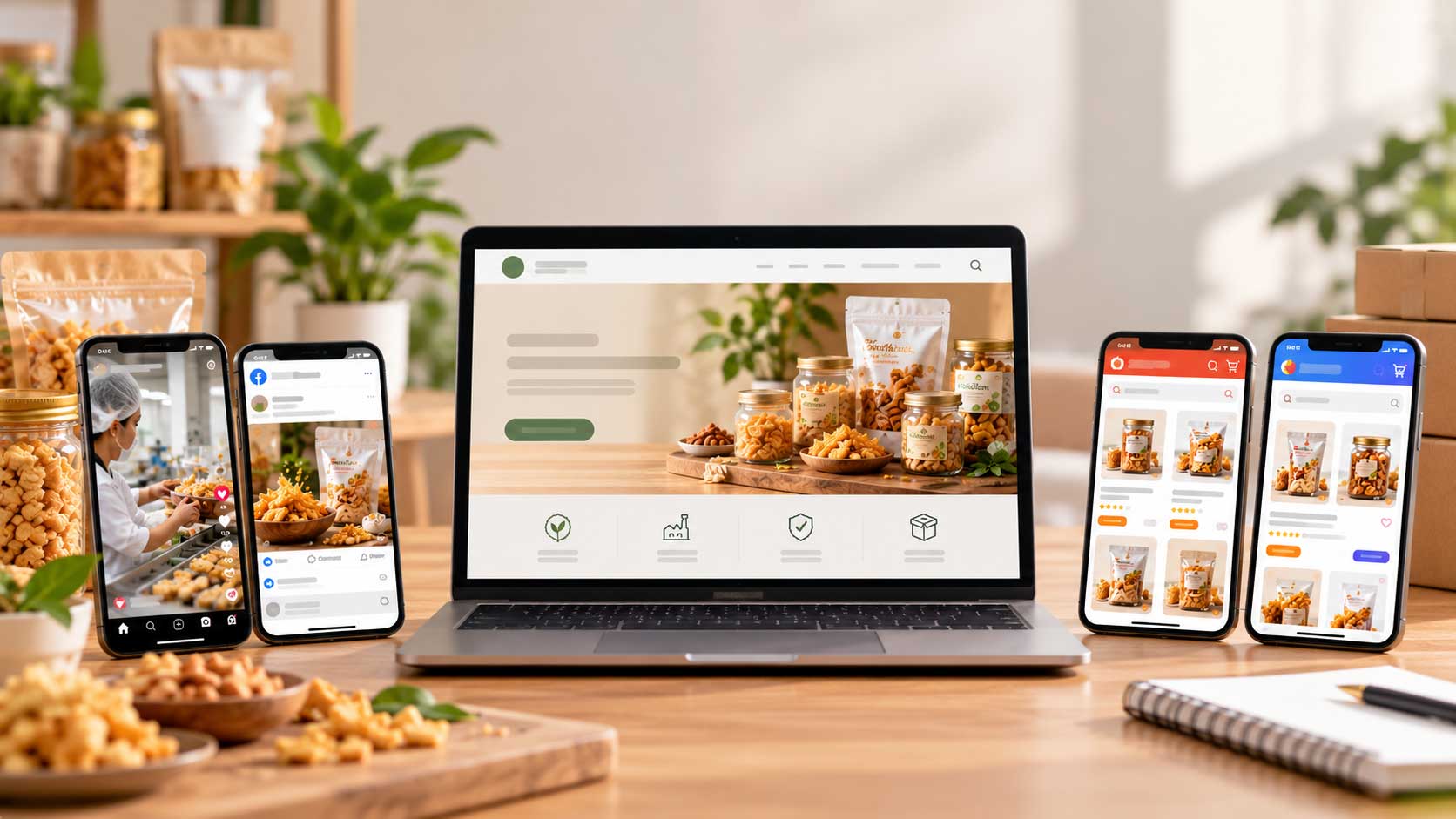
Company Website, Social Media & Marketplaces: How Can They Work Together?
If your food business is already using Facebook, TikTok, Shopee or Lazada, you may already have several useful channels to reach customers.
So, where does a Company Website fit in?
The good news is that you do not have to choose one over the other.
Social media, marketplaces and your own website can work together, with each platform supporting a different part of your online presence.
Social media can help people discover your brand and interact with your content. Marketplaces can make it convenient for customers to browse and purchase products. A Company Website can give people a dedicated place to learn more about your company, products, capabilities and services.
For a food business in Malaysia, this can be especially useful when you serve different types of customers.
For example, a food manufacturer in Johor may use social media to share product updates, a marketplace to reach retail customers, and a Business Website to provide detailed information for distributors or business enquiries.
If the company also works with customers in Johor Bahru or Singapore, having organised company information online can make it easier for potential business partners to understand what the company does.
So the question is not:
“Should I use a website or social media?”
It is:
“How can I make these platforms work together?”
Here are 7 ways to look at it.
1. Each Platform Has a Different Role
The easiest way to understand how these channels can work together is to look at what each one does best.
| Platform | Main Role | Useful For |
|---|---|---|
| Company Website | Company information and enquiries | Company profile, products, capabilities, certifications |
| Content and interaction | Updates, photos, community engagement | |
| TikTok | Content and discovery | Short videos, product visibility, brand awareness |
| Shopee / Lazada | Online Shopping | Product listings, orders and transactions |
This does not mean one platform is better than another.
They are simply built around different customer needs.
For example, Facebook and TikTok can be useful for sharing new products, factory activities, behind-the-scenes content or short videos.
Shopee and Lazada can make it easier for customers to browse products, compare options and place orders.
A Company Website can bring more detailed business information together in one place.
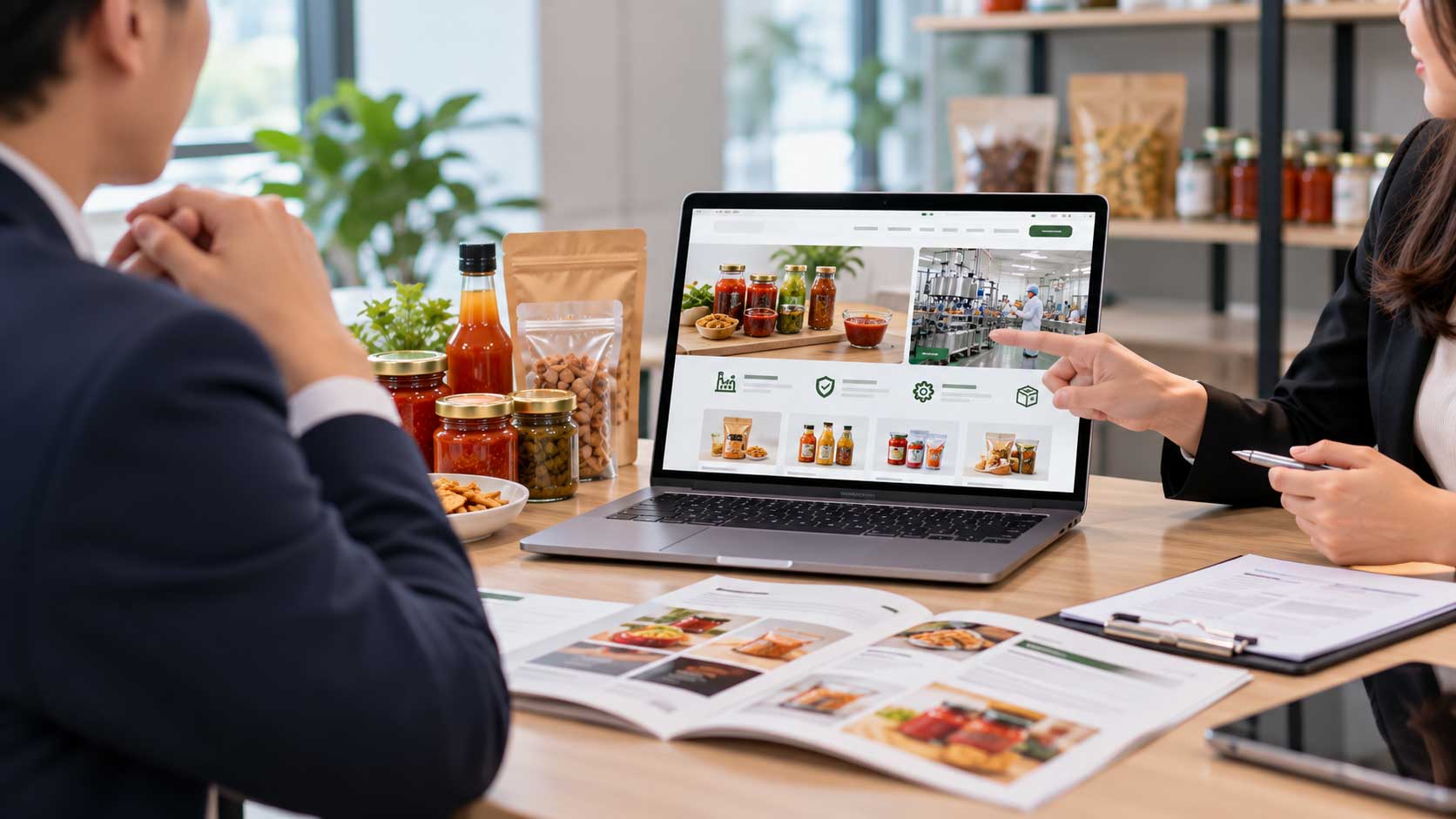
For a food manufacturer, a Business Website may include:
- Company Profile
- Products
- Manufacturing Capabilities
- Factory & Facilities
- OEM / Private Label
- Certifications & Standards
- Markets & Industries
- FAQ
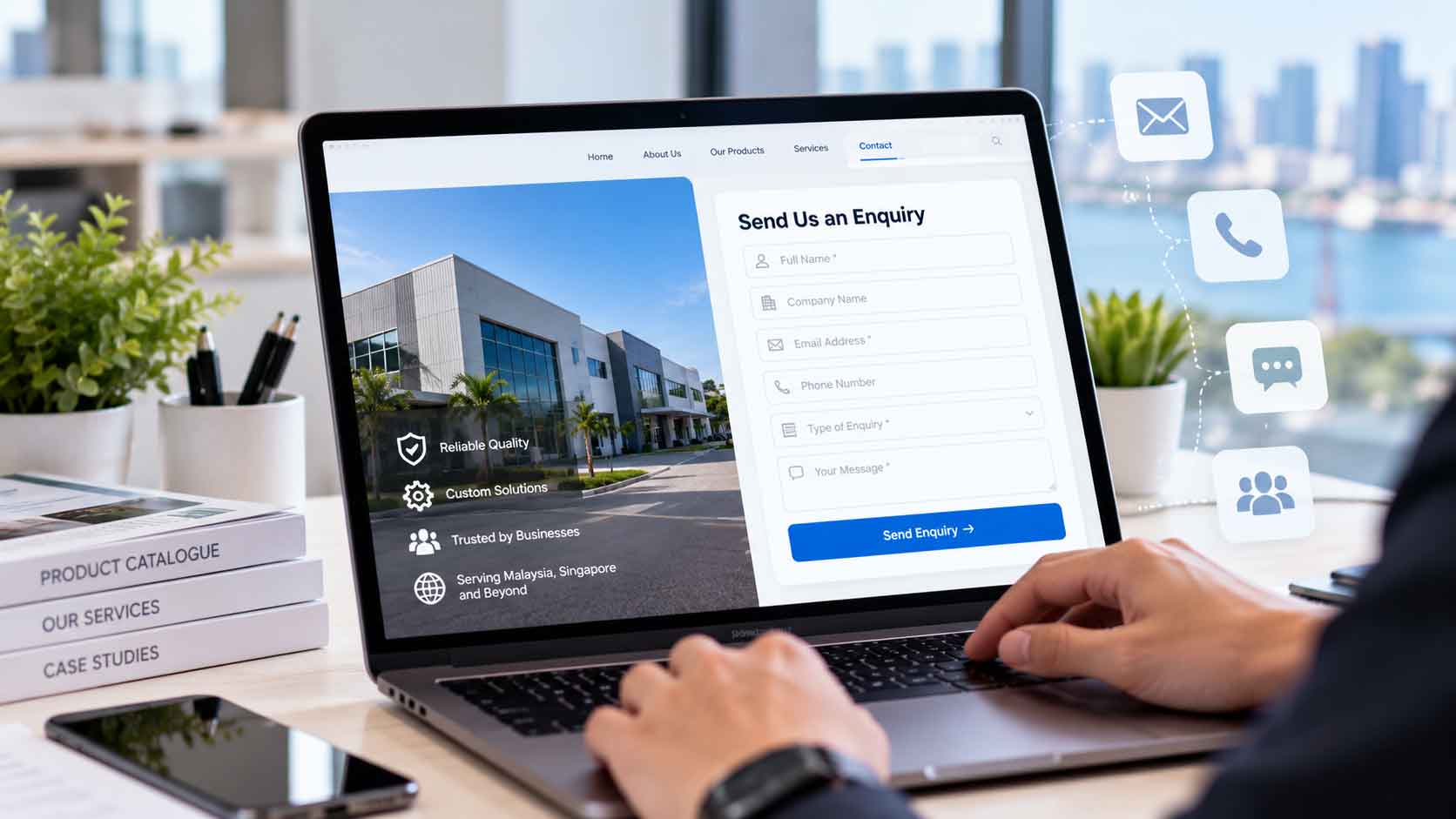
- Contact & Enquiry
The goal is not to make one platform do everything.
It is to let each platform do what it is good at.
If you are still deciding what type of website your food business needs, you can also read our previous guide on Food Industry Website design in Malaysia to explore the different website types and planning considerations.
2. Social Media Can Help People Discover Your Brand

Social media plays an important role in helping businesses stay visible and connected with their audience.
Facebook and TikTok, for example, can be useful for:
- Sharing new products
- Posting behind-the-scenes content
- Showing factory activities
- Sharing short videos
- Introducing promotions
- Interacting with followers
- Building brand awareness
Imagine a food manufacturer in Johor Bahru launching a new product.
The company could share a short video on TikTok, post product photos on Facebook and continue updating customers through social media.
Someone who discovers the brand through these channels may then want to know more about the company.
This is where a Company Website can come in naturally.
Instead of expecting a social media profile to explain everything, the business can direct interested visitors to its website, where they can find more detailed information about the company and its products.
In this way, social media does not compete with your website.
It can help bring people to it.
3. Marketplaces Make Product Discovery and Buying Convenient
For businesses that sell products online, marketplaces such as Shopee and Lazada can be very useful.
Customers are already familiar with these platforms and can browse products, compare options, read reviews and place orders within the same environment.
For consumer food brands, this can make the purchasing process simple and convenient.
For example, a customer may discover a snack brand through TikTok, visit its Shopee store to check the available products, and place an order there.
That is a useful customer journey.
There is no reason for a Company Website to replace that process.
Instead, the website can support the parts of the customer journey that require more information.
For example, a visitor may want to know:
- Who is behind the brand?
- What other products does the company offer?
- Does the company manufacture its own products?
- Does it offer OEM or private-label services?
- Where is the company located?
- How can a business customer get in touch?
These are areas where a Business Website can provide additional information alongside the marketplace.
The marketplace helps customers buy.
The website helps them learn more about the business.
Both can be useful.
4. Company Website vs Social Media: How Can They Work Together?
Rather than looking at company website vs social media as a competition, it may be more useful to look at the customer journey.
A potential customer might:
Discover → Explore → Learn → Enquire → Purchase
Different platforms can support different stages.
Social Media
Social media can help with discovery and engagement.
A customer may see a TikTok video, Facebook post or product update and become interested in the brand.
Marketplace
A marketplace can support product discovery and purchase.
If the customer is ready to buy, Shopee or Lazada can provide a convenient place to browse products and complete the transaction.
Company Website
A Company Website can support the learning and enquiry stage.
This is especially useful when the customer wants to understand the company in more detail.
For example, a potential distributor may want to see:
- Product range
- Manufacturing capabilities
- Factory facilities
- Certifications
- OEM / Private Label options
- Contact information
Instead of searching through years of social media posts, they can visit the Business Website and find the information in a more organised way.
This is how the platforms can support each other instead of competing with each other.
5. Your Website Can Give Your Business a Dedicated Information Hub
One benefit of having your own Company Website is having a dedicated space to organise your business information.
This can be especially helpful for B2B businesses.
A social media post may be useful today, but as more posts are published, older information can become harder to find.
A marketplace listing is useful for selling a particular product, but it may not be the best place to explain your entire business.
A Business Website can bring these different types of information together.
For example:
Company → Products → Capabilities → Facilities → Certifications → Services → Enquiry
A potential customer can move through the information based on what they want to know.
For food manufacturers, this can be useful when dealing with distributors, retailers, OEM enquiries or business buyers who want to understand the company before starting a conversation.
This does not mean your website needs to be huge.
It simply needs to contain the information that matters to your customers.
6. A Business Website Can Support Your Overall Online Visibility
Having a Business Website does not automatically mean your website will rank well on Google.
SEO still depends on many factors, including useful and relevant content, technical setup, page experience and how well your website meets what people are searching for.
However, your own website gives you a dedicated place to organise and publish information about your business.
For example, a food manufacturer could create useful pages about:
- Food manufacturing capabilities
- OEM food production
- Private-label services
- Product categories
- Packaging solutions
- Manufacturing locations
- Industry applications
These pages can give visitors more information while also helping search engines understand what the business offers.
At the same time, social media and other online platforms can contribute to your wider online presence.
Google also provides resources for understanding how social media and video content can appear in Google Search. Google Search Central: Social Media and Video Content
So, rather than thinking that SEO belongs only to your website, it is better to see your online channels as different parts of the same overall presence.
Your Company Website can provide the detailed information, while social media can help share content and reach people who may be interested in your brand.
7. You Do Not Have to Choose Between Them
This is perhaps the most important point.
You do not need to stop using Facebook because you have a Company Website.
You do not need to stop using TikTok because you have a website.
You do not need to stop selling on Shopee or Lazada.
Instead, you can let each channel support a different part of your business.
Use Social Media To:
- Share regular updates
- Show products and activities
- Create short-form content
- Interact with your audience
- Help people discover your brand
Use Marketplaces To:
- List products
- Support online purchases
- Manage transactions
- Reach customers who prefer marketplace shopping
Use Your Company Website To:
- Explain your business
- Present your full product range
- Show manufacturing capabilities
- Display certifications
- Introduce your facilities
- Explain OEM / Private Label services
- Provide a clear enquiry process
The result is not about having more platforms just for the sake of it.
It is about giving customers different ways to discover, explore and connect with your business.
If your existing website already has useful information but no longer reflects your current business, a Website Revamp may be enough to bring it up to date.
How Can Malaysian Food Businesses Use These Channels Together?

For food businesses in Malaysia, the right combination will depend on what you sell and who your customers are.
If You Are a Food Manufacturer
Your Company Website can focus on products, manufacturing capabilities, facilities, certifications and business enquiries.
Social media can then be used to show factory activities, product updates and company news.
If You Are a Consumer Food Brand
Your website can support your brand story, product information and customer information.
Facebook and TikTok can help you share content and engage with your audience, while Shopee or Lazada can support online purchases.
If You Are an OEM / Private-Label Manufacturer
Your Business Website can explain your manufacturing capabilities, production process, product categories and enquiry process.
Social media can still be useful for showing your facilities, products and company activities.
If You Are a Food Packaging Supplier
Your website can organise product specifications, materials, applications and other technical information.
Social media can then be used to share product updates, projects and industry-related content.
For businesses in Johor and Johor Bahru, this combination can also be useful when reaching customers outside the local market.
For example, a manufacturer may use social media to build awareness locally while using its Company Website to provide detailed information for potential B2B customers from other parts of Malaysia or Singapore.
The goal is not to be active on every platform.
The goal is to make each platform useful.
Conclusion: Build Your Own Website and Let Your Channels Work Together
The best approach is not about choosing one platform over another.
Your Company Website, social media and marketplaces can support each other.
Social media can help people discover and engage with your brand.
Marketplaces can make it convenient for customers to browse and purchase your products.
Your own website can bring your company information, products, capabilities and contact options together in one place.
Imagine a potential customer discovers your food brand through TikTok.
They then visit your Facebook page to see more updates, find your products on Shopee, and later visit your Business Website because they want to learn more about your company or explore a business enquiry.
Each platform has helped at a different stage.
That is the real value of having them work together.
A Company Website does not need to replace the platforms you are already using.
Instead, it can become the place where interested customers go when they want to understand your business in more detail.
For food manufacturers, a well-organised Food Manufacturing Website can bring products, capabilities, facilities and enquiry information together.
If you are planning a new website, you can also explore our Website Development services.
And if you already have a clear idea of what you need, you can Contact Us to discuss your requirements.


Company Website, Social Media & Marketplaces: How Can They Work Together?
If your food business is already using Facebook, TikTok, Shopee or Lazada, you may already have several useful channels to reach customers.
So, where does a Company Website fit in?
The good news is that you do not have to choose one over the other.
Social media, marketplaces and your own website can work together, with each platform supporting a different part of your online presence.
Social media can help people discover your brand and interact with your content. Marketplaces can make it convenient for customers to browse and purchase products. A Company Website can give people a dedicated place to learn more about your company, products, capabilities and services.
For a food business in Malaysia, this can be especially useful when you serve different types of customers.
For example, a food manufacturer in Johor may use social media to share product updates, a marketplace to reach retail customers, and a Business Website to provide detailed information for distributors or business enquiries.
If the company also works with customers in Johor Bahru or Singapore, having organised company information online can make it easier for potential business partners to understand what the company does.
So the question is not:
“Should I use a website or social media?”
It is:
“How can I make these platforms work together?”
Here are 7 ways to look at it.
1. Each Platform Has a Different Role
The easiest way to understand how these channels can work together is to look at what each one does best.
| Platform | Main Role | Useful For |
|---|---|---|
| Company Website | Company information and enquiries | Company profile, products, capabilities, certifications |
| Content and interaction | Updates, photos, community engagement | |
| TikTok | Content and discovery | Short videos, product visibility, brand awareness |
| Shopee / Lazada | Online Shopping | Product listings, orders and transactions |
This does not mean one platform is better than another.
They are simply built around different customer needs.
For example, Facebook and TikTok can be useful for sharing new products, factory activities, behind-the-scenes content or short videos.
Shopee and Lazada can make it easier for customers to browse products, compare options and place orders.
A Company Website can bring more detailed business information together in one place.
For a food manufacturer, a Business Website may include:
- Company Profile
- Products
- Manufacturing Capabilities
- Factory & Facilities
- OEM / Private Label
- Certifications & Standards
- Markets & Industries
- FAQ
- Contact & Enquiry
The goal is not to make one platform do everything.
It is to let each platform do what it is good at.
If you are still deciding what type of website your food business needs, you can also read our previous guide on Food Industry Website design in Malaysia to explore the different website types and planning considerations.
2. Social Media Can Help People Discover Your Brand
Social media plays an important role in helping businesses stay visible and connected with their audience.
Facebook and TikTok, for example, can be useful for:
- Sharing new products
- Posting behind-the-scenes content
- Showing factory activities
- Sharing short videos
- Introducing promotions
- Interacting with followers
- Building brand awareness
Imagine a food manufacturer in Johor Bahru launching a new product.
The company could share a short video on TikTok, post product photos on Facebook and continue updating customers through social media.
Someone who discovers the brand through these channels may then want to know more about the company.
This is where a Company Website can come in naturally.
Instead of expecting a social media profile to explain everything, the business can direct interested visitors to its website, where they can find more detailed information about the company and its products.
In this way, social media does not compete with your website.
It can help bring people to it.
3. Marketplaces Make Product Discovery and Buying Convenient
For businesses that sell products online, marketplaces such as Shopee and Lazada can be very useful.
Customers are already familiar with these platforms and can browse products, compare options, read reviews and place orders within the same environment.
For consumer food brands, this can make the purchasing process simple and convenient.
For example, a customer may discover a snack brand through TikTok, visit its Shopee store to check the available products, and place an order there.
That is a useful customer journey.
There is no reason for a Company Website to replace that process.
Instead, the website can support the parts of the customer journey that require more information.
For example, a visitor may want to know:
- Who is behind the brand?
- What other products does the company offer?
- Does the company manufacture its own products?
- Does it offer OEM or private-label services?
- Where is the company located?
- How can a business customer get in touch?
These are areas where a Business Website can provide additional information alongside the marketplace.
The marketplace helps customers buy.
The website helps them learn more about the business.
Both can be useful.
4. Company Website vs Social Media: How Can They Work Together?
Rather than looking at company website vs social media as a competition, it may be more useful to look at the customer journey.
A potential customer might:
Discover → Explore → Learn → Enquire → Purchase
Different platforms can support different stages.
Social Media
Social media can help with discovery and engagement.
A customer may see a TikTok video, Facebook post or product update and become interested in the brand.
Marketplace
A marketplace can support product discovery and purchase.
If the customer is ready to buy, Shopee or Lazada can provide a convenient place to browse products and complete the transaction.
Company Website
A Company Website can support the learning and enquiry stage.
This is especially useful when the customer wants to understand the company in more detail.
For example, a potential distributor may want to see:
- Product range
- Manufacturing capabilities
- Factory facilities
- Certifications
- OEM / Private Label options
- Contact information
Instead of searching through years of social media posts, they can visit the Business Website and find the information in a more organised way.
This is how the platforms can support each other instead of competing with each other.
5. Your Website Can Give Your Business a Dedicated Information Hub
One benefit of having your own Company Website is having a dedicated space to organise your business information.
This can be especially helpful for B2B businesses.
A social media post may be useful today, but as more posts are published, older information can become harder to find.
A marketplace listing is useful for selling a particular product, but it may not be the best place to explain your entire business.
A Business Website can bring these different types of information together.
For example:
Company → Products → Capabilities → Facilities → Certifications → Services → Enquiry
A potential customer can move through the information based on what they want to know.
For food manufacturers, this can be useful when dealing with distributors, retailers, OEM enquiries or business buyers who want to understand the company before starting a conversation.
This does not mean your website needs to be huge.
It simply needs to contain the information that matters to your customers.
6. A Business Website Can Support Your Overall Online Visibility
Having a Business Website does not automatically mean your website will rank well on Google.
SEO still depends on many factors, including useful and relevant content, technical setup, page experience and how well your website meets what people are searching for.
However, your own website gives you a dedicated place to organise and publish information about your business.
For example, a food manufacturer could create useful pages about:
- Food manufacturing capabilities
- OEM food production
- Private-label services
- Product categories
- Packaging solutions
- Manufacturing locations
- Industry applications
These pages can give visitors more information while also helping search engines understand what the business offers.
At the same time, social media and other online platforms can contribute to your wider online presence.
Google also provides resources for understanding how social media and video content can appear in Google Search. Google Search Central: Social Media and Video Content
So, rather than thinking that SEO belongs only to your website, it is better to see your online channels as different parts of the same overall presence.
Your Company Website can provide the detailed information, while social media can help share content and reach people who may be interested in your brand.
7. You Do Not Have to Choose Between Them
This is perhaps the most important point.
You do not need to stop using Facebook because you have a Company Website.
You do not need to stop using TikTok because you have a website.
You do not need to stop selling on Shopee or Lazada.
Instead, you can let each channel support a different part of your business.
Use Social Media To:
- Share regular updates
- Show products and activities
- Create short-form content
- Interact with your audience
- Help people discover your brand
Use Marketplaces To:
- List products
- Support online purchases
- Manage transactions
- Reach customers who prefer marketplace shopping
Use Your Company Website To:
- Explain your business
- Present your full product range
- Show manufacturing capabilities
- Display certifications
- Introduce your facilities
- Explain OEM / Private Label services
- Provide a clear enquiry process
The result is not about having more platforms just for the sake of it.
It is about giving customers different ways to discover, explore and connect with your business.
If your existing website already has useful information but no longer reflects your current business, a Website Revamp may be enough to bring it up to date.
How Can Malaysian Food Businesses Use These Channels Together?
For food businesses in Malaysia, the right combination will depend on what you sell and who your customers are.
If You Are a Food Manufacturer
Your Company Website can focus on products, manufacturing capabilities, facilities, certifications and business enquiries.
Social media can then be used to show factory activities, product updates and company news.
If You Are a Consumer Food Brand
Your website can support your brand story, product information and customer information.
Facebook and TikTok can help you share content and engage with your audience, while Shopee or Lazada can support online purchases.
If You Are an OEM / Private-Label Manufacturer
Your Business Website can explain your manufacturing capabilities, production process, product categories and enquiry process.
Social media can still be useful for showing your facilities, products and company activities.
If You Are a Food Packaging Supplier
Your website can organise product specifications, materials, applications and other technical information.
Social media can then be used to share product updates, projects and industry-related content.
For businesses in Johor and Johor Bahru, this combination can also be useful when reaching customers outside the local market.
For example, a manufacturer may use social media to build awareness locally while using its Company Website to provide detailed information for potential B2B customers from other parts of Malaysia or Singapore.
The goal is not to be active on every platform.
The goal is to make each platform useful.
Conclusion: Build Your Own Website and Let Your Channels Work Together
The best approach is not about choosing one platform over another.
Your Company Website, social media and marketplaces can support each other.
Social media can help people discover and engage with your brand.
Marketplaces can make it convenient for customers to browse and purchase your products.
Your own website can bring your company information, products, capabilities and contact options together in one place.
Imagine a potential customer discovers your food brand through TikTok.
They then visit your Facebook page to see more updates, find your products on Shopee, and later visit your Business Website because they want to learn more about your company or explore a business enquiry.
Each platform has helped at a different stage.
That is the real value of having them work together.
A Company Website does not need to replace the platforms you are already using.
Instead, it can become the place where interested customers go when they want to understand your business in more detail.
For food manufacturers, a well-organised Food Manufacturing Website can bring products, capabilities, facilities and enquiry information together.
If you are planning a new website, you can also explore our Website Development services.
And if you already have a clear idea of what you need, you can Contact Us to discuss your requirements.


